Chemical ID, plume modeling, and protective action zones.
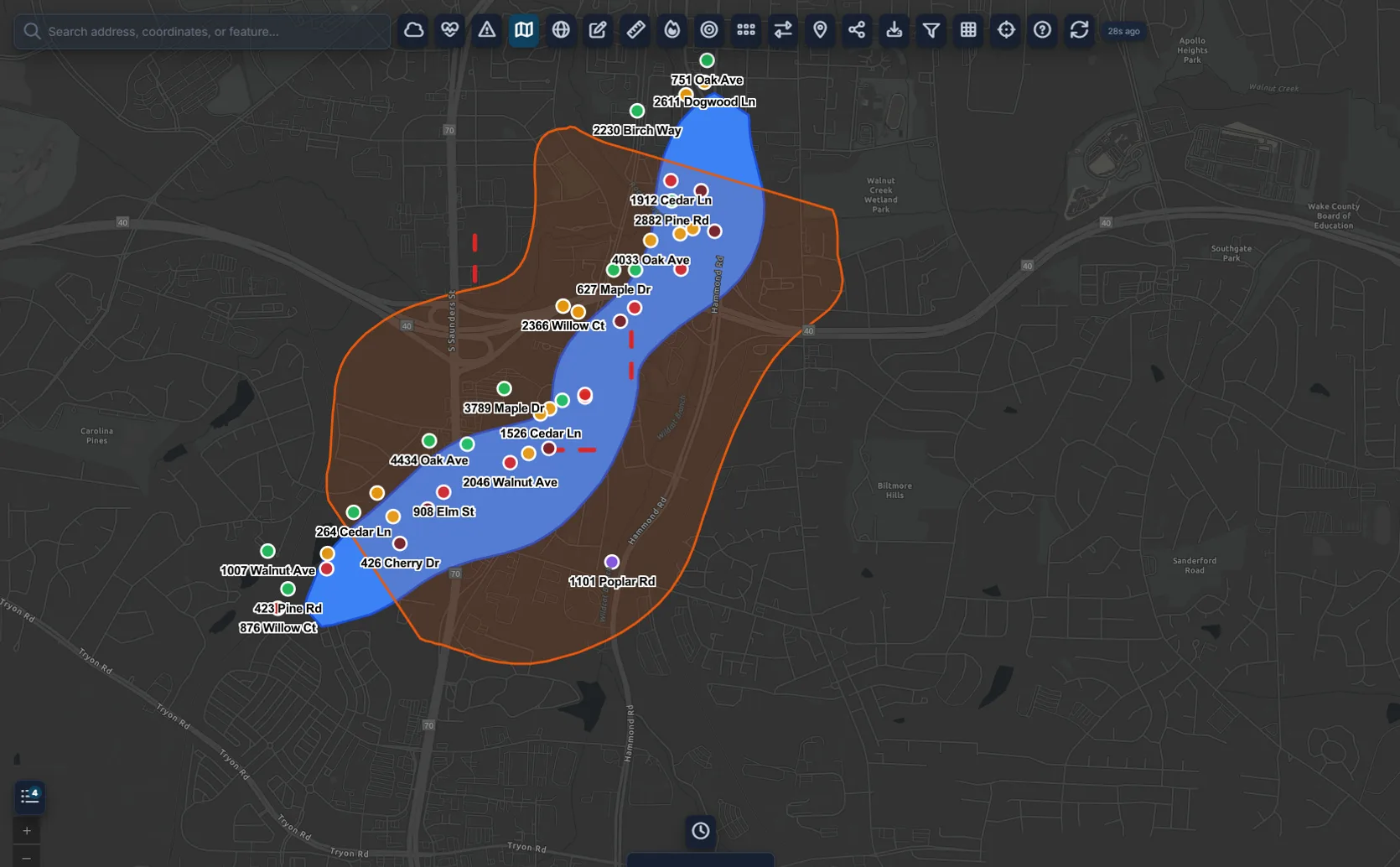
Document hazmat releases with chemical identification, atmospheric conditions, Gaussian plume modeling, and HYSPLIT atmospheric transport — all mapped on your operational view.
The problem
Hazmat response demands precision — not paper lookup tables
Chemical identification, protective distances, and plume prediction require speed and accuracy that manual methods struggle to deliver under pressure.
Manual ERG lookups
Flipping through the Emergency Response Guidebook under pressure wastes time and risks error. Initial isolation distances need to be calculated and communicated immediately.
No dispersion modeling in the field
Plume prediction tools are separate systems that don't connect to your incident. Results have to be manually transferred to your operational map.
Protective zones on paper
Isolation and evacuation zones are drawn on paper maps or described verbally. Field teams and command may have different understandings of the boundaries.
Integrated hazmat tools
Chemical database, plume modeling, and protective actions — on your map
Identify the chemical, record atmospheric conditions, model the dispersion plume, and generate protective action zones — all rendered directly on your operational map and shared with every team member in real time.
Built for hazmat operations
Chemical ID, plume modeling, zones, and documentation
Chemical identification
Look up chemicals by name, UN/NA number, or CAS number. Get immediate hazard classification, protective action distances, and ERG guidance.
Integrated chemical database with ERG recommendations.
Plume modeling
Gaussian plume dispersion modeling calculates downwind concentration zones based on release rate, wind conditions, and atmospheric stability.
HYSPLIT integration for atmospheric transport over longer distances.
Protective action zones
Automatically generate isolation and protective action zones on your operational map based on chemical properties and atmospheric conditions.
Evacuation boundaries drawn and shared with your entire team in real time.
Mapped on your operational view
Plume overlays, isolation zones, and protective action distances render directly on the same map you use for all other operations.
No separate system. No separate map. Everything in context.
See HAZMAT response tools in action
Start a free 90-day trial and explore chemical identification, plume modeling, and protective action zones on the operational map.