From activation to closure. Every decision documented.
Manage every incident through a structured lifecycle — command staff assignment, operational periods, AI-powered briefings, and multi-agency coordination — with a complete audit trail.
The problem
Incident management shouldn't mean managing spreadsheets
When command staff is tracking incidents in email threads, shared drives, and whiteboards, critical information falls through the cracks.
No single source of truth
Incident status lives in one place, staff assignments in another, and operational objectives in a third. Briefings start with "let me pull up the latest..."
Multi-incident chaos
Running concurrent events means juggling separate tracking systems for each. Context switches between incidents cost time and introduce errors.
Partner agencies are blind
Mutual aid partners get updates by phone or email. They can't see your operational picture, and you can't see theirs.
Full incident lifecycle
Structured workflow from activation to closure
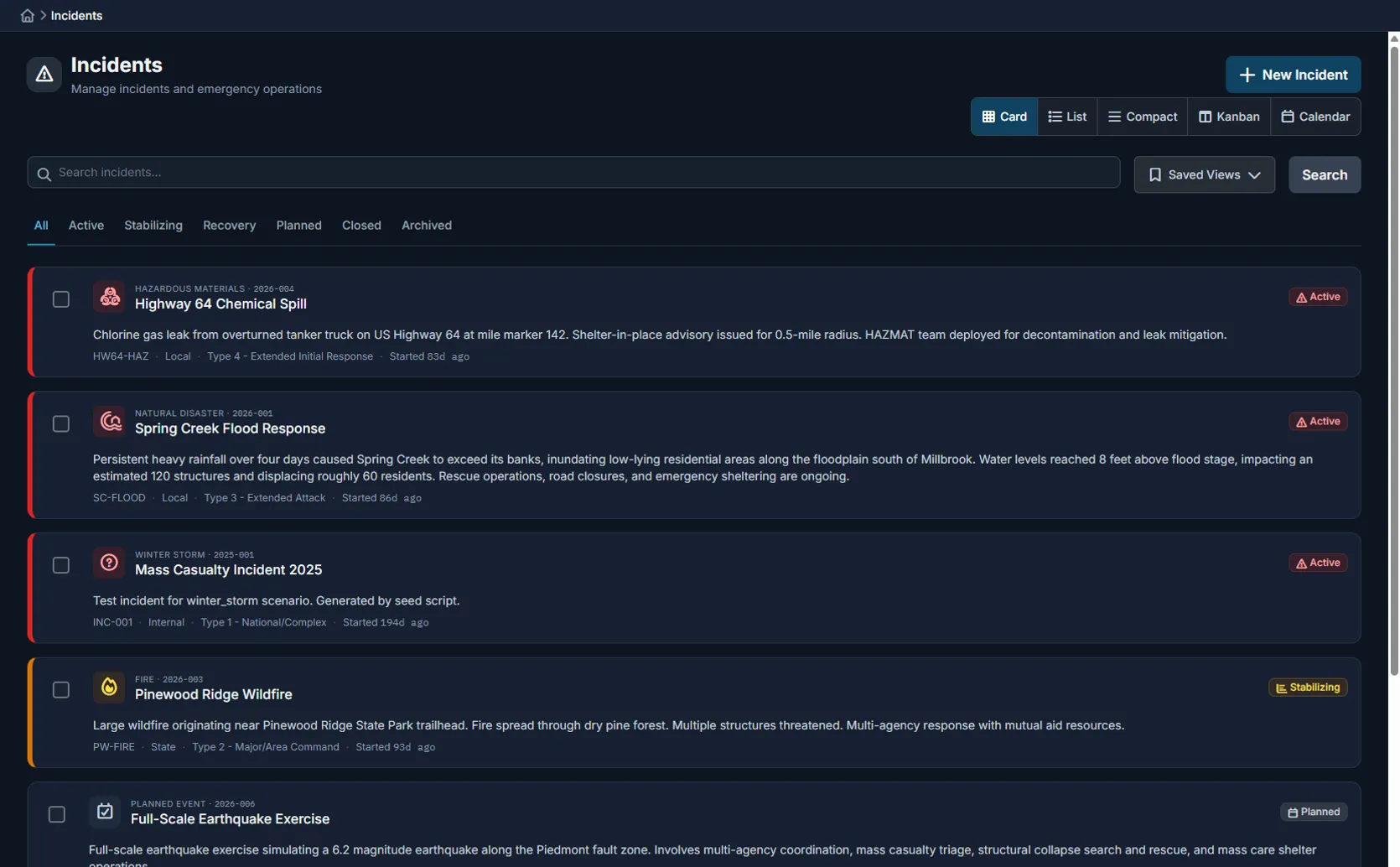
Every incident follows a consistent, auditable lifecycle. Create it, activate it, manage operational periods, and close it — with every decision, status change, and handoff logged automatically.
Interagency coordination
Share incident data without losing control
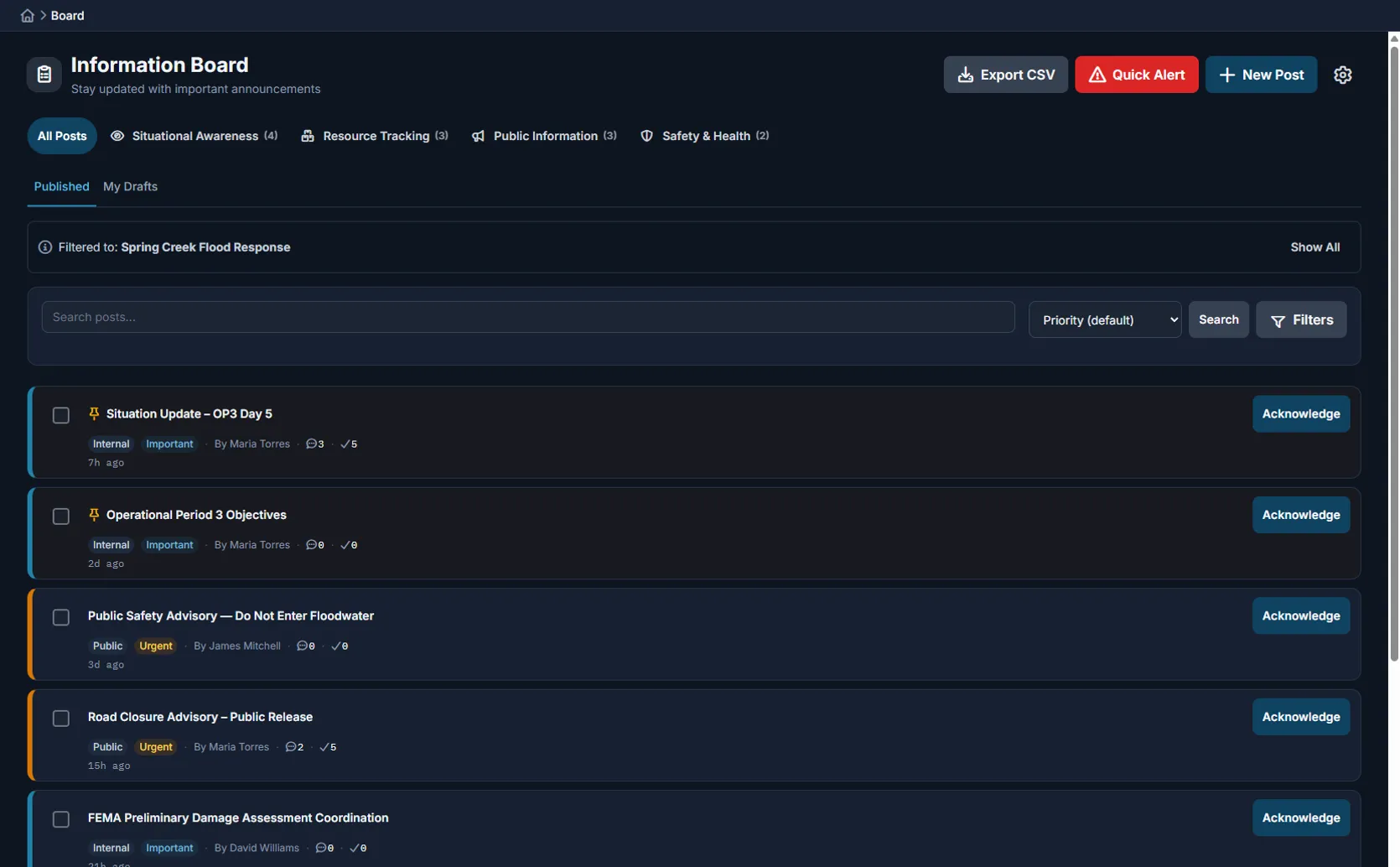
When mutual aid partners need situational awareness, share your incident data through a controlled workflow. They see it in their own environment. You revoke access when the operation ends.
Built for incident commanders
ICS structure, AI briefings, and multi-agency operations
Full ICS structure
Assign command and general staff across all ICS positions. Track qualifications and maintain a clear chain of command throughout the incident.
IC, Operations, Planning, Logistics, Finance — every position tracked.
Multi-incident operations
Manage concurrent incidents from one dashboard. Each incident has its own workspace, staff assignments, and data — no cross-contamination.
Wildfire and flood at the same time? Each stays organized.
AI-powered briefings
Generate instant incident summaries from operational data — tasks, damage reports, status updates, and resource deployments compiled into a briefing document.
Instant situational awareness without reading pages of logs.
Multi-agency sharing
Share incident data with mutual aid partners through a controlled workflow. They see it in their system. You revoke access any time.
Coordinate without losing control of your data.
Not a standalone tool
Part of the complete Command Bridge platform
Incident command connects to mapping, ICS forms, field operations, notifications, FEMA recovery, and every other module in the platform.
Unified operational map
Every data layer on one canvas — personnel, weather, damage, road closures.
Digital ICS forms
Auto-populated from incident data with collaborative editing and digital signatures.
Field operations
Mobile app with full offline capability for damage assessments and supply requests.
Multi-channel notifications
Text, email, voice, and push notifications from one compose screen.
Recovery & FEMA tracking
PA category costs tracked during response — ready for FEMA submission.
Automation & AI
Workflow builder, weather triggers, and AI-powered incident summaries.
See incident command in action
Start a free 90-day trial and manage the full incident lifecycle — from activation to after-action review.